The original Xbox One and the Xbox One S have a GPU that lands close to an AMD Radeon HD 7790 or an NVIDIA GeForce GTX 750 Ti. The more powerful Xbox One X is a different story. Its graphics chip is roughly on par with a Radeon RX 580 or a GTX 1060 6GB. So the right answer depends on which Xbox One you own, and this guide breaks down all three.
Below you’ll find a quick comparison table, the real specs behind each console, and a plain explanation of why a console GPU tends to feel faster than its numbers suggest. That last part matters, because raw specs alone will steer you wrong.
A quick note before the numbers. There is no single graphics card that is a perfect copy of any Xbox One. The console uses a custom chip that AMD built to Microsoft’s order, so every equivalent here is a close cousin rather than an identical twin. When people say a card is “equivalent,” they mean it delivers a similar gaming experience, not that the two chips are wired the same way. Keep that in mind and the comparisons will make a lot more sense.
What is the Xbox One GPU equivalent?
Here’s the short version in one table. Use it to find your console, then read the section below it for the details that actually affect how a game runs.
| Console model | Rough PC card match | Compute power |
|---|---|---|
| Xbox One (2013) | Radeon HD 7790 / GTX 750 Ti | 1.31 TFLOPS |
| Xbox One S (2016) | Radeon HD 7790 / GTX 750 Ti | 1.4 TFLOPS |
| Xbox One X (2017) | Radeon RX 580 / GTX 1060 6GB | 6 TFLOPS |
Quick take: an original Xbox One is a budget 2013-era card, and an Xbox One X is a solid 1080p-to-1440p card from around 2017. Neither is a modern gaming GPU, but the One X still holds up for many older titles.
What’s actually inside the Xbox One GPU?
The Xbox One doesn’t use an off-the-shelf graphics card. It uses a custom AMD chip built into the same piece of silicon as the processor, a setup called an APU (a chip that combines the CPU and GPU). That design keeps the console small and cheap, but it also means there’s no exact PC twin. The closest match is whichever desktop card has similar power.
The graphics part is based on AMD’s Graphics Core Next design, the same family behind AMD’s Radeon cards from that era. The original Xbox One runs 768 shader cores (the tiny units that do the math for lighting, textures, and effects) at 853 MHz. That works out to about 1.31 TFLOPS of compute power. A TFLOP is just a way to measure raw number-crunching speed, and higher is better for graphics.
For memory, the original console shares 8GB of DDR3 across the whole system, with a small pool of fast on-chip memory to make up for the slower main RAM. This is why a plain spec-for-spec comparison to a PC card gets tricky. The console shares one memory pool between the game code and the graphics, while a PC card has its own dedicated video memory.
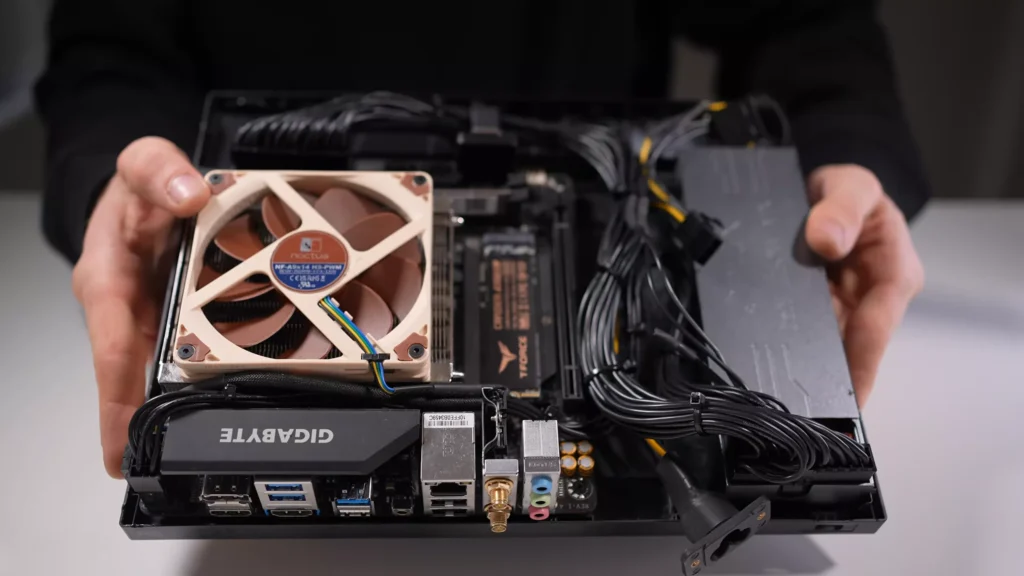
A couple of the numbers are worth unpacking, since they show up in every comparison. The compute unit is the basic building block of an AMD GPU. Each one packs 64 shader cores, so the original Xbox One’s 12 active compute units give you those 768 cores. The chip actually has 14 units built in, but two are switched off to improve manufacturing yield, a common trick that lets more chips pass quality checks. The clock speed, 853 MHz here, is how fast those cores run. Multiply cores by clock speed by the work each core does per cycle and you land at the TFLOPS figure. None of this has to be memorized, but knowing what drives the number helps you judge whether a PC card really lines up.
The chip is made on a 28-nanometer process, which was standard for graphics hardware in 2013. Newer cards use much smaller processes, which is a big reason a modern budget card can beat the console while sipping far less power. Process size is basically how tightly the transistors are packed, and smaller usually means faster and more efficient.
Original Xbox One and Xbox One S: about a Radeon HD 7790
For the 2013 Xbox One, the honest match is a Radeon HD 7790. Both use the same AMD graphics family and land within a hair of each other on shader count and compute power. The 7790 puts out a touch more raw compute, which fits, since the console holds a little back for its operating system and background tasks.
On the NVIDIA side, the GTX 750 Ti is the usual pick. Across a large spread of games these two cards trade blows and land within about one percent of each other, so either one is a fair stand-in. The 750 Ti uses less power and carries a bit more video memory, while the 7790 has more raw compute. In practice they feel the same.
The Xbox One S, released in 2016, is a smaller, cooler redesign rather than a power upgrade. Its GPU clock is nudged up slightly, lifting output to around 1.4 TFLOPS, but that’s a small bump. For graphics purposes the One S matches the same cards as the launch console: a Radeon HD 7790 or a GTX 750 Ti. The One S added 4K video playback and HDR, but those are display features, not extra gaming muscle.
If you’re wondering why the same GPU appears twice, it comes down to what Microsoft changed between the two consoles. The One S shrank the chip to a smaller manufacturing process, which let the console run cooler and quieter in a smaller case. That efficiency gain funded a tiny clock bump, but it wasn’t meant to boost game performance in any real way. Games that ran on the launch console run the same on the One S. So when you’re matching either one to a PC card, you’re looking at the same pair of budget options.
What this means in practice: the original Xbox One and One S were built for 1080p gaming, and many games actually ran at 900p to keep the frame rate steady. Most titles targeted 30 frames per second.
For context on where that sits today, a Radeon HD 7790 or GTX 750 Ti is now firmly in retro territory. These cards handle older esports titles and lighter indie games at 1080p, but they struggle with anything demanding released in the last several years. That tells you plainly how the base Xbox One ages: fine for its own library, but not a target you’d aim for when building a PC now.
Xbox One X: about a Radeon RX 580
The Xbox One X from 2017 is a large jump, not a small one. Its custom GPU runs 40 compute units (2,560 shader cores) at up to 1172 MHz, delivering roughly 6 TFLOPS. That is more than four times the compute of the original console, which is why the One X could push many games to 4K.
The closest PC match is the Radeon RX 580. The One X’s chip borrows from AMD’s Polaris design, the same technology behind the RX 500 series, and it hits the same 6 TFLOPS mark. On the NVIDIA side, the GTX 1060 6GB is the everyday equivalent. On paper the 1060 shows a slightly lower TFLOPS figure, but its architecture is efficient enough that real games often land in the same range.
Some people reach for a GTX 1070 as the match. That is usually too generous. The One X’s slower Jaguar processor (the CPU part of the chip) holds the graphics back in real games, so a 1070-class card would pull ahead once you put both in demanding titles. For a fair comparison, the RX 580 and GTX 1060 6GB are the safer answers, with a 1070 only relevant if you want to clearly beat the console.
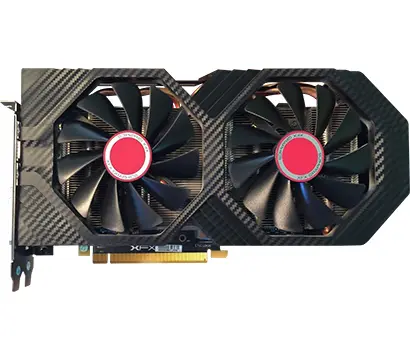
The One X also carries 12GB of shared GDDR5 memory, with up to 9GB available to games. That generous memory buffer is part of why it handled 4K textures well, sometimes better than a stock RX 580 with 8GB. If you want the official rundown of the console’s hardware, Microsoft’s Xbox One X product page covers the headline specs.
It’s also worth separating the two things a graphics chip does: raw power and memory bandwidth. The One X pairs its 6 TFLOPS with 326 GB/s of memory bandwidth, which is how quickly the chip can move data in and out of memory. That fast memory is a big reason the console could push 4K, since higher resolutions need a lot more data flowing every second. A stock RX 580 sits in a similar bandwidth range, which is part of why the two feel so close in practice.
So which name should you use when someone asks? For a like-for-like performance match, go with the RX 580 or GTX 1060 6GB. If you only care about the underlying technology, the One X is a Polaris chip, the same family as AMD’s RX 500 cards. Both answers are correct; they just answer slightly different questions. The RX 580 happens to satisfy both, which is why it’s the name you’ll hear most often.
Why a console GPU beats its raw specs
Here’s the part that trips people up. A console almost always performs better than a PC card with the same TFLOPS number. The gap comes down to a few real advantages built into the console design.
- Fixed hardware. Every Xbox One is identical, so developers tune a game for one exact chip. PC games have to run on thousands of hardware combinations, which leaves performance on the table.
- Lower overhead. A console talks to its graphics chip more directly than a PC does through Windows and its drivers. Less software sits between the game and the hardware, so more of the chip’s power reaches the screen.
- Shared memory. The CPU and GPU share one memory pool, so data doesn’t have to be copied back and forth the way it often does on a PC.
- Custom tricks. Consoles include small pieces of dedicated hardware for tasks like moving data around, which frees up the main chip for actual rendering.
Add these up and a 1.31 TFLOPS console can match a PC card rated a bit higher. This is why a spec-sheet showdown never tells the whole story, and why any equivalent card is an estimate rather than an exact twin.
Can you build a PC that matches an Xbox One?
You can, though for the older consoles it barely makes sense today. To match an original Xbox One or One S, any modern budget or entry-level graphics card will clear that bar with room to spare. Even low-cost current cards outrun a Radeon HD 7790 by a wide margin, so you’d never shop for a 7790 on purpose now.
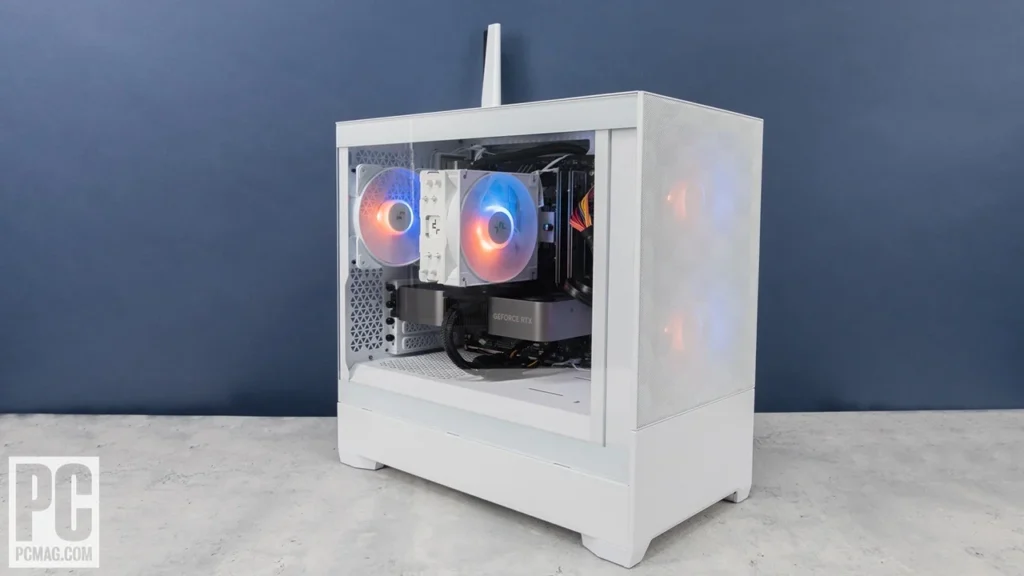
Matching an Xbox One X is more interesting, since 6 TFLOPS is still respectable for 1080p gaming. A used RX 580, a GTX 1060 6GB, or any modern entry-level card in that performance class will get you there. Pair it with a mid-range processor, since the console’s weak CPU was its main limit, and a PC will actually pull ahead in games that lean on the processor.
One thing to keep in mind: the PC needs more than a matching graphics card. You also want enough system memory, a decent CPU, and a drive with room for large game installs. The console bundles all of that into one box, which is a big part of its value. If you’re comparing prices, remember you’re comparing a whole system to a single part. AMD’s own Radeon graphics lineup is a good place to see where current cards land if you’re pricing an upgrade.
What resolution and frame rate to expect
Numbers are easier to picture once you tie them to real gameplay. An original Xbox One or One S was tuned for 1080p output, but plenty of games quietly dropped to 900p to keep things smooth, and most held to 30 frames per second. If you match that console with an old 7790 or 750 Ti on a PC, expect the same ballpark: 1080p on older or lighter games, and not much headroom beyond that.
The Xbox One X changed the target to 4K, though that often meant a mix of native 4K and clever upscaling rather than true 4K in every game. Match it on a PC with an RX 580 or GTX 1060 6GB and you’ll get comfortable 1080p at high settings, solid 1440p in many titles, and 4K only in lighter games. The console squeezes a bit more out of its hardware than the PC card will, but the experience is close enough that the comparison holds up.
Frequently asked questions
Is the Xbox One GPU good in 2026?
The original Xbox One GPU is dated and only suits older or lighter games at 1080p. The Xbox One X still holds up well for 1080p and some 1440p gaming, thanks to its 6 TFLOPS chip.
Is the Xbox One X GPU better than a GTX 1060?
They’re very close. The Xbox One X roughly matches a GTX 1060 6GB in real games, and console optimization sometimes gives the Xbox a slight edge in titles built for it.
How many TFLOPS is the Xbox One?
The original Xbox One puts out about 1.31 TFLOPS. The Xbox One S is around 1.4 TFLOPS, and the Xbox One X reaches roughly 6 TFLOPS, more than four times the launch console.
Does the Xbox One use an AMD or NVIDIA GPU?
Every Xbox One model uses a custom AMD graphics chip built into the same silicon as the processor. There is no NVIDIA hardware inside any Xbox One console.
Can a cheap graphics card beat the Xbox One X?
Modern entry-level cards can match or beat the Xbox One X’s raw graphics power. To pull clearly ahead in real games, pair one with a mid-range CPU, since the console’s processor was its weak point.
Conclusion
If you own an original Xbox One or an Xbox One S, its GPU is about as strong as a Radeon HD 7790 or GTX 750 Ti, both budget cards from the early 2010s. The Xbox One X is far stronger and sits near a Radeon RX 580 or GTX 1060 6GB. Treat these as close estimates, not exact twins, because console optimization lets the hardware punch above its raw numbers. For a matching PC today, any modern entry-level card easily clears the bar.
Related Post:
LM Studio GPU Not Detected? Here’s How to Fix It
What Does the Ti Mean in a GPU? Nvidia’s Ti Suffix Explained
How to Switch From an NVIDIA to an AMD GPU (Clean, Step by Step)
How to Change Thermal Paste on a GPU (Step-by-Step)
AMD Processor With Nvidia GPU: Does It Work, and Should You Do It?