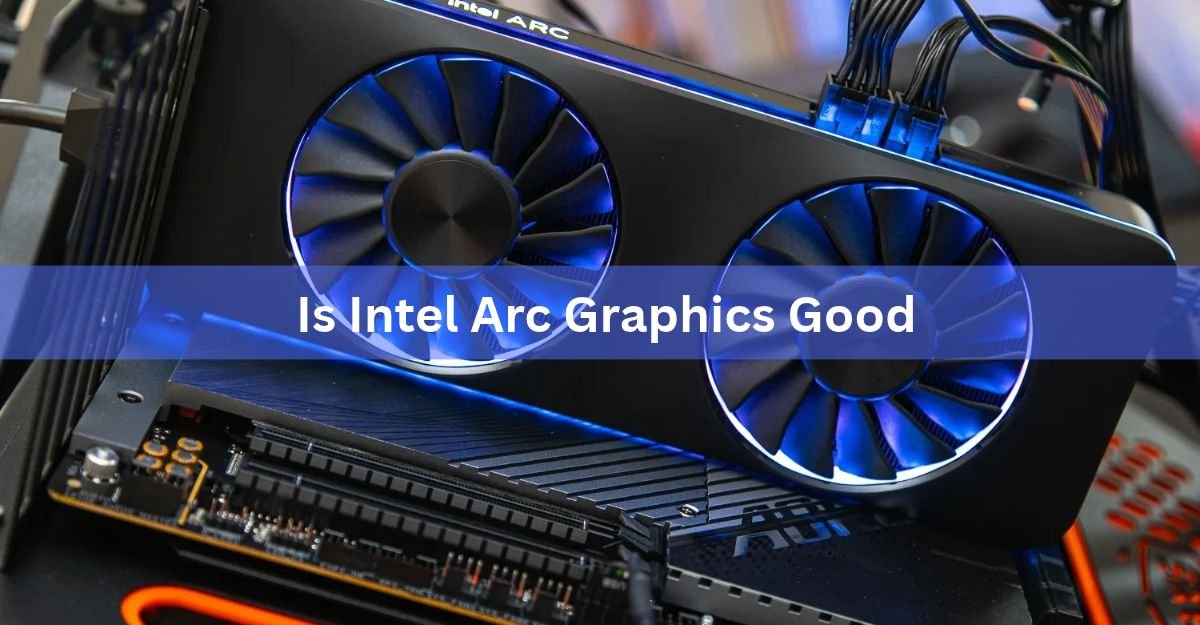
Yes, Intel Arc graphics are good now. The short version: the Arc B580 is one of the best value graphics cards you can buy around $250, and the Arc graphics built into Intel’s newer Core Ultra laptops can run real games at smooth frame rates. There are two things that decide whether Arc is right for you, your processor and your resolution, and this guide walks through both in plain terms.
Arc had a rough start back in 2022. If your memory of it is “buggy and slow,” that picture is out of date. Intel has shipped a steady stream of driver updates, launched a much better second generation, and fixed the biggest flaw of its budget cards during 2025. Here is where things actually stand.
What “Intel Arc” actually means
“Intel Arc” is a single brand that covers two very different products, and mixing them up is the most common source of confusion.
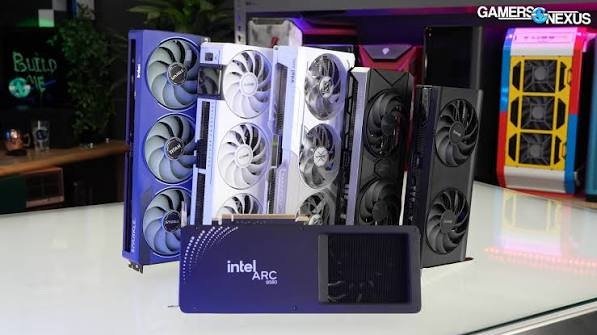
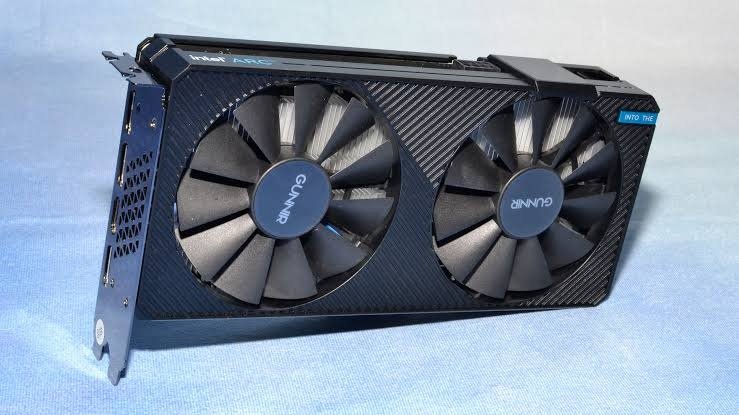
The first is discrete desktop graphics cards, the kind you slot into a desktop PC. The current generation is called Battlemage, and the main card is the Arc B580, joined by the cheaper B570. The older first generation was called Alchemist (the A770, A750, A580, and A380).
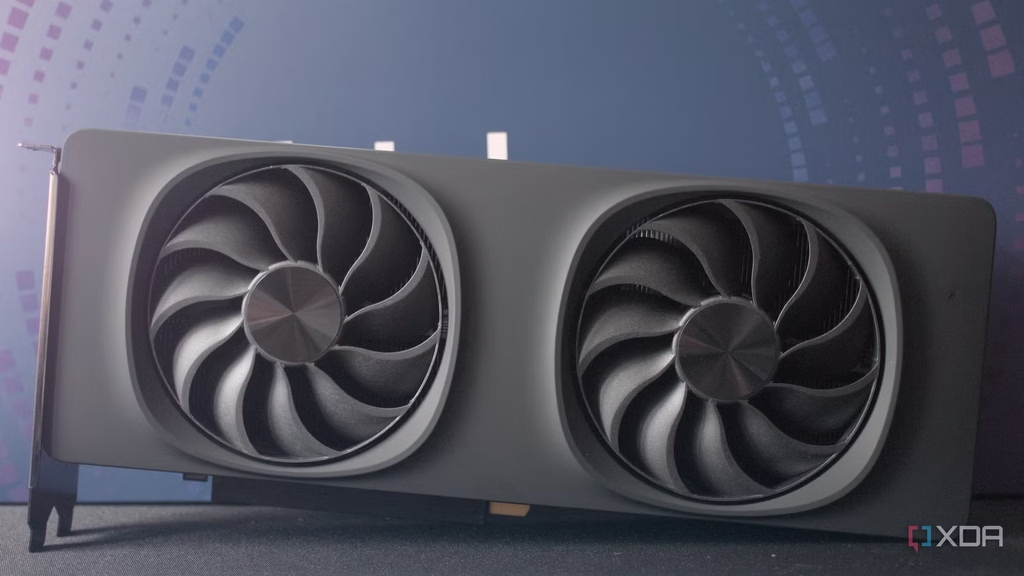
The second is integrated graphics built into Intel’s laptop chips. The strongest version is the Arc Graphics 140V, found in Core Ultra Series 2 laptops. It shares no silicon with the desktop cards, but it carries the same Arc name and the same core features like XeSS upscaling and AV1 video.
Quick rule of thumb: if you are building a desktop, “Arc” means the B580 card. If you are shopping for a thin laptop, “Arc” means the graphics baked into a Core Ultra chip. The answer to “is it good” is yes for both, but for different reasons.
How Intel Arc performs for gaming
For gaming, the Arc B580 is the card that put Intel back on the map. It launched in December 2024 at $249 and was built around a clear idea: give budget buyers a true 1440p card instead of only 1080p. It carries 12GB of video memory on a 192-bit bus, which is 50% more memory than the 8GB rivals it was priced against.
That extra memory matters more every year. Modern games load in high-resolution textures that eat up VRAM, and once a card runs out, frame rates fall off a cliff and textures turn muddy. An 8GB card can hit that wall at 1440p in demanding titles. The B580’s 12GB gives it breathing room where cheaper cards choke.
In testing, the B580 trades blows with and often beats Nvidia’s RTX 4060 and AMD’s RX 7600, the two cards it was built to challenge, while costing less than both. In some games the gap is small. In others, like Cyberpunk 2077 and F1 24, the B580 pulls a clear lead. Its ray tracing, the lighting feature that usually tanks budget cards, holds up better than you would expect at this price.
What resolution should you aim for?
Treat the B580 as a strong 1080p card and a very capable 1440p card for most games at high settings. At 1080p it has power to spare. At 1440p it handles the majority of current titles well, and the 12GB buffer is exactly what keeps it playable there. Push into 4K and you will need to lower settings and lean on upscaling.
On the laptop side, the Arc Graphics 140V is genuinely strong for an integrated chip. In independent testing it edged past the laptop version of Nvidia’s GeForce RTX 3050 in 3DMark, and it can deliver 60 frames per second in many games at 1080p. For a GPU with no dedicated card and no extra power draw, that is a real leap. It will not replace a gaming laptop with a discrete GPU, but for a slim ultrabook it means esports titles and plenty of mainstream games are fully playable.
The numbers at a glance
Here is how the current desktop Arc cards and the top laptop Arc chip compare on the specs that affect real performance.
| Arc B580 | Arc B570 | Arc 140V (laptop) | |
|---|---|---|---|
| Type | Desktop card | Desktop card | Integrated |
| Architecture | Battlemage (Xe2) | Battlemage (Xe2) | Xe2 |
| VRAM | 12GB GDDR6 | 10GB GDDR6 | Shared system RAM |
| Memory bus | 192-bit | 160-bit | n/a |
| Board power | 190W | 150W | Part of chip |
| Launch price | $249 | $219 | In laptop price |
| Best for | 1440p gaming | 1080p gaming | Thin-laptop gaming |
Both desktop cards run on a single 8-pin power connector and use modern display outputs (HDMI 2.1 and DisplayPort 2.1), so they fit comfortably in a small or budget build.
Are Intel Arc drivers still a problem?
Drivers were Arc’s original weak spot, and they are the thing most people still worry about. The honest answer in 2026: they are in good shape, and far better than the early days. Intel updates Arc drivers often, and those updates do not just fix bugs, they regularly add real performance.
The first-generation Alchemist cards shipped with genuine problems, especially in older games built on older graphics code, where performance could be erratic. Battlemage launched in a much better state, and the gap between Arc and the smoother driver experience from Nvidia and AMD has narrowed a lot.
You can download the latest driver from Intel’s own Arc graphics drivers page, and it is worth doing right after you install the card. Arc genuinely improves over time, so keeping current is not optional busywork, it is how you get the performance you paid for.
The practical takeaway: Arc rewards people who update drivers and mostly play modern games. If you only ever play older or very obscure titles, test your favorites or check that they run well before committing.
The one thing to check first: your CPU
This is the single most important part of this guide, so do not skip it. The Arc B580 had a flaw that was easy to miss on a review bench but painful at home: CPU overhead. In plain terms, Arc leaned harder on your processor than rival cards did. Paired with a fast modern CPU, the card flew. Paired with an older or budget CPU, it could lose a big chunk of its performance, sometimes 20% or more, for no obvious reason.
That mattered because the people most likely to buy a $250 card are often the same people running an older processor. It was the wrong weakness for a budget card to have.
The good news: Intel fixed much of it through software. Starting with the driver update known as the 7028 branch in late August 2025, the overhead dropped sharply in key games. In independent testing, pairing the B580 with a mid-range Ryzen 5 5600 saw frame rates jump by as much as 36% in affected titles from a driver update alone, bringing it in line with equivalent cards. It is not a total fix across every game, but the worst of it is behind us.
So here is the rule. If you pair an Arc B580 with a reasonably modern processor and the latest drivers, you get the performance the reviews promised. If you are dropping it into a much older system, update drivers first and check benchmarks for the specific games you play.
Intel Arc for video editing, streaming, and AV1
Gaming is only half the story. Arc is quietly excellent for anyone who works with video, and this is an area where it can outclass pricier cards.
Every Arc GPU, desktop and laptop, includes hardware support for AV1, a modern video format that delivers better quality at smaller file sizes. Intel was first to bring consumer hardware AV1 encoding to graphics, and it still does it well. If you stream to Twitch or YouTube, upload a lot of video, or want smaller recordings without a quality hit, that AV1 engine is a real perk.
For editors, Arc’s media engine chews through timeline playback and exports nicely in software that supports it. If you spend as much time in a video editor as in games, Arc can be the smarter buy at its price, not a compromise.
Is Intel Arc good value in 2026?
Value is where Arc wins most clearly. The whole point of the B580 is price-to-performance, and it delivers. You get a 1440p-capable card with 12GB of memory for around $250, in a market where comparable 1440p cards from the big two have often cost noticeably more, and where cheaper options usually drop you to 8GB and 1080p.
A few honest caveats keep this grounded:
- Street prices move. The $249 figure is the launch price. Depending on stock and demand, the card has sometimes sold above that, so compare the actual price you see against current RTX and Radeon options before you buy.
- Idle power could be better. The B580 draws more power when sitting idle than some rivals. It is a minor running cost, not a dealbreaker.
- It is not a high-end card. Arc competes hard in the budget and mid-range tiers. If you want top-tier 4K performance, you are shopping in a different, far more expensive category.
For laptop Arc, the value math is different because you do not buy the GPU separately, you buy a laptop that happens to include capable graphics. The upside is a thin, light machine with no separate gaming GPU that can still play real games. That is excellent value if you want one laptop for work, travel, and the occasional gaming session.
Who should buy Intel Arc, and who should skip it
Arc is a smart, confident choice for a clear set of people, and a poor fit for a few others. Here is the quick sort.
Intel Arc is a great pick if you
Are building a budget or mid-range gaming PC around $250 for the GPU.
Want solid 1080p and good 1440p gaming without overpaying.
Have a modern processor, or will update drivers and check your games if your CPU is older.
Stream, record, or edit video and want strong AV1 support for the money.
Are buying a thin Core Ultra laptop and want graphics that can actually game a little.
Look elsewhere if you
Want maximum performance at 4K or the highest refresh rates, that is a different price class.
Mostly play very old or niche games where driver support can be hit or miss.
Are pairing it with an old CPU and are not willing to update drivers or verify performance first.
For most people shopping in the budget lane, none of those exceptions apply, and the answer lands firmly on the yes side.
Frequently asked questions
Is the Intel Arc B580 good for gaming?
Yes. The B580 is one of the best value cards around $250, handling 1080p easily and most games at 1440p on high settings. Its 12GB of memory helps it stay smooth where cheaper 8GB cards struggle.
Is Intel Arc better than Nvidia?
At the budget level, Arc often wins on price and memory. The B580 matches or beats the RTX 4060 while costing less. At the high end, Nvidia still leads clearly. For most under-$300 builds, Arc is very competitive.
Do Intel Arc drivers still cause problems?
Much less than before. Drivers are updated often and keep adding performance. Modern games run well. Keep drivers current, and if you play very old titles, check that your favorites run smoothly first.
Is Intel Arc graphics 140V good enough for gaming?
For integrated graphics, yes. The Arc 140V in Core Ultra laptops can hit 60 FPS in many games at 1080p and beats the laptop RTX 3050 in some tests. It suits esports and mainstream titles, not maxed-out AAA gaming.
Why does my Intel Arc card feel slow with an older CPU?
That was the CPU overhead issue. Intel largely fixed it in driver updates from the 7028 branch in late 2025, with big frame rate gains on mid-range chips. Update to the latest driver to get that improvement.
Conclusion
Intel Arc graphics are good, and in 2026 that is a confident yes rather than a hopeful one. The Arc B580 gives budget builders a 1440p-capable card with 12GB of memory for around $250, and the Arc graphics in Core Ultra laptops punch well above their weight. Buy Arc if you have a modern CPU and keep your drivers current. Do that, and a good result looks like smooth frames in modern games at a price the competition struggles to match.
Related Post:
Is 8GB of VRAM Enough in 2026? The Honest Answer by Resolution
Is an 8GB Graphics Card Good? A Straight Answer for Your Setup
Are All GPUs Compatible With All Motherboards?
Is 16GB VRAM Enough for 1440p Gaming?