The Radeon 890M performs about on par with an NVIDIA GTX 1650 desktop graphics card, and it sits just below an RTX 2050 laptop GPU. That is the short answer. In some games and tests it even reaches up toward the old GTX 1070. The catch is that the 890M is built into the processor, not a separate card, so the exact match shifts depending on the laptop or mini PC it lives in.
If you just want a mental shortcut: think GTX 1650. Below is what that really means for gaming, for everyday work, and why two machines with the same 890M can post different numbers.
What is the Radeon 890M?
The Radeon 890M is AMD’s fastest integrated graphics chip from 2024. Integrated means it shares the same silicon as the processor rather than being a plug-in card. It ships inside AMD’s Ryzen AI 300 laptop and mini-PC chips, also known by the code name Strix Point. The flagship chip you will see it paired with is the AMD’s Ryzen AI 9 HX 370 page.
It uses AMD’s RDNA 3.5 graphics design and packs 16 compute units, which work out to 1,024 stream processors, running at up to 2,900 MHz. It also includes hardware for ray tracing and AI tasks. Here are the core specs at a glance.
| Spec | Radeon 890M |
| Architecture | RDNA 3.5 |
| Compute units | 16 (1,024 stream processors) |
| Peak clock | Up to 2,900 MHz |
| Ray accelerators | 16 |
| AI accelerators | 32 |
| Process node | 4 nm (TSMC N4P) |
| Found in | Ryzen AI 300 (Strix Point) chips |
| Typical power | About 10 to 30 watts |
The key idea: an integrated GPU now delivers the kind of frame rates that used to need a low-cost graphics card, while sipping only 10 to 30 watts.
How the 890M stacks up against NVIDIA cards
Line the 890M up next to NVIDIA’s lineup and it slots into the entry-level tier. The everyday match is the GTX 1650. In synthetic tests it can climb higher: its Vulkan compute score comes in right next to the GTX 1070, and its 3DMark Time Spy result lands just under an RTX 2050 laptop chip, roughly 3,600 points against about 3,700. Against a GTX 1650 Super it trails by around 15 percent.
The table below turns those numbers into a simple placement. Treat it as a map, not a promise, since results move with the game and the machine.
| NVIDIA card | How it compares | Rough gap |
| GTX 1650 (desktop) | The closest everyday match | Trades wins game to game |
| GTX 1070 | Matches it in some compute tests | Near level in Vulkan |
| RTX 2050 (laptop) | 890M sits just below | About 3% behind on Time Spy |
| GTX 1650 Super | 890M is a bit slower | Around 15% behind |
| RTX 3060 / RTX 4060 | Much stronger than the 890M | Not in the same class |
One thing to keep straight: synthetic benchmarks and real games do not always agree. A compute test might put the 890M level with a GTX 1070, but in an actual game the honest, repeatable comparison is the GTX 1650. When someone asks for a single equivalent, the GTX 1650 is the safe answer, and the TechPowerUp’s 890M spec sheet is a good place to check the raw figures yourself.
What that means for gaming
The 890M is a genuine 1080p gaming chip for the right titles. Older and well-optimized games run smoothly at 1080p with medium or high settings. Newer, heavier games are playable at 1080p if you drop to low or medium settings, and upscaling features like AMD’s FSR help you claw back frames.
Here is a realistic picture of what to expect:
- Esports and lighter games (CS2, Rocket League, Valorant, Dota 2): smooth 1080p, often at high settings.
- Big 2023 titles (Baldur’s Gate 3): playable at 1080p medium.
- Heavy 2024 AAA games (Cyberpunk 2077): aim for 1080p low, and lean on FSR.
- 1440p: possible in lighter titles, but 1080p is the safer target for steady frame rates.
In direct game tests against a GTX 1650, the results swing both ways. The 890M pulled ahead in God of War and Forza Horizon 5, ran close in Devil May Cry 5, and fell a little behind in a couple of older games. That back-and-forth is exactly why the GTX 1650 is the fair everyday equivalent.
Where it beats a discrete card, and where it falls short
The 890M’s biggest strength is efficiency. It matches an entry-level desktop card while drawing a fraction of the power, which is why it fits in thin laptops and palm-sized mini PCs with no separate graphics card at all. For a lot of people, that means a smaller, quieter, cheaper machine that still games.
Its limits are just as clear:
Shared memory: it borrows system RAM instead of having its own fast video memory, so slow RAM chokes it.
Shared power and heat: the graphics and the processor draw from one power and thermal budget, so a hot, cramped chassis holds it back.
A ceiling: it is not close to a modern midrange card. An RTX 3060 or RTX 4060 is far stronger and remains the pick for serious 1440p or high-refresh gaming.
Why two 890M laptops can score differently
You may see the same “Radeon 890M” label produce very different frame rates from one machine to the next. That is normal for integrated graphics, and three things drive it.
- Sustained power. The chip can be set anywhere from around 15 watts to over 50 watts. More sustained watts means more performance. A mini PC that holds 54 watts will crush a thin laptop capped at 25.
- Cooling. If the chassis cannot shed heat, the chip slows itself down to stay safe, which drags down the smoothness of your frame rate, not just the average.
- Memory speed. Because it uses system RAM as video memory, faster memory (LPDDR5X at 7500 MT/s or better) noticeably lifts results. Slow or single-channel RAM is a real handbrake.
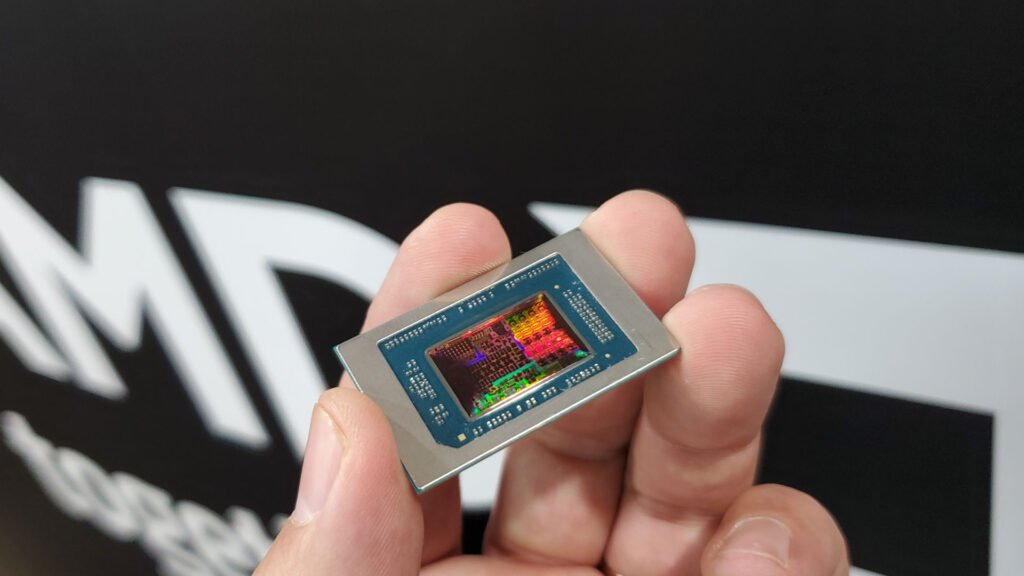
If you want the best from an 890M, look for a device with fast dual-channel memory and a cooling design that lets the chip run at a higher, sustained power level.
Is the Radeon 890M enough for you?
It comes down to what you play and how you use the machine. The 890M is a strong fit if you want 1080p gaming without carrying a bulky gaming laptop, if you do light content creation and photo work, or if you want a tiny mini PC that can still handle a game after work. It plays modern titles at sensible settings and older ones with room to spare.
It is the wrong tool if you want high frame rates at 1440p or 4K, if you play the newest AAA games maxed out, or if you do heavy video rendering or 3D work every day. Those jobs still call for a proper discrete card like an RTX 4060 or better. For most everyday users, though, the 890M covers far more than an integrated chip used to.
Frequently asked questions
Is the Radeon 890M equivalent to a GTX 1650?
Yes, that is the closest everyday match. In real games the 890M trades wins with a GTX 1650, sometimes beating it and sometimes falling just short. It is the safest single answer when you want one familiar comparison.
Can the Radeon 890M run modern AAA games?
Yes, at 1080p with low to medium settings, and it helps to turn on FSR upscaling. Lighter and older games run smoothly at higher settings. Aim for 1080p rather than 1440p for steady frame rates.
Is the 890M better than the RTX 3060?
No. An RTX 3060 is much stronger, with well over 80 percent more gaming performance in aggregate tests. The 890M is an entry-level integrated chip, while the 3060 is a midrange discrete card built for higher settings and resolutions.
Why does my 890M perform worse than benchmarks show?
Usually power, cooling, or memory. A thin laptop that caps the chip at low wattage, throttles under heat, or uses slow single-channel RAM will score below a well-cooled mini PC with fast dual-channel memory running the same 890M.
How much better is the 890M than the 780M?
Meaningfully, but not by a fixed amount. The 890M has 16 compute units and RDNA 3.5 versus 12 units and RDNA 3 on the 780M. Compute tests show gains of around 40 percent, though real-game uplift varies by title and machine.
Conclusion
Treat the Radeon 890M as roughly a GTX 1650: solid 1080p gaming, entry-level power, and enough for older and lighter titles at good settings plus newer ones at lower settings. In some tests it reaches toward a GTX 1070 or an RTX 2050. To get the most from it, pick a device with fast dual-channel memory, a higher sustained power limit, and good cooling. Set your sights on smooth 1080p and it will not let you down.
Related Post:
Why NZXT CAM Doesn’t Show Your GPU Temp (and How to Fix It)
Xbox One GPU Equivalent: What PC Graphics Card Matches Each Model
LM Studio GPU Not Detected? Here’s How to Fix It
How to Make Minecraft Use Your GPU (Fix Lag and Low FPS)
What Does the Ti Mean in a GPU? Nvidia’s Ti Suffix Explained