The Steam Deck runs on integrated AMD RDNA 2 graphics, and in real games it lands closest to a desktop NVIDIA GTX 1050 Ti or an AMD Radeon RX 560. In well-optimized titles it can nudge toward GTX 1650 territory, especially at the low resolutions the Deck is built for. That is the short version. The longer version matters, because the Steam Deck does not have a graphics card in the normal sense, so any single equivalent is an approximation rather than a clean swap.
If you are deciding between a Steam Deck and a budget PC build, or you just want to picture the kind of performance you will get, this comparison gives you a working model. It also explains why the numbers on the spec sheet undersell what the device actually does.
What graphics does the Steam Deck use?
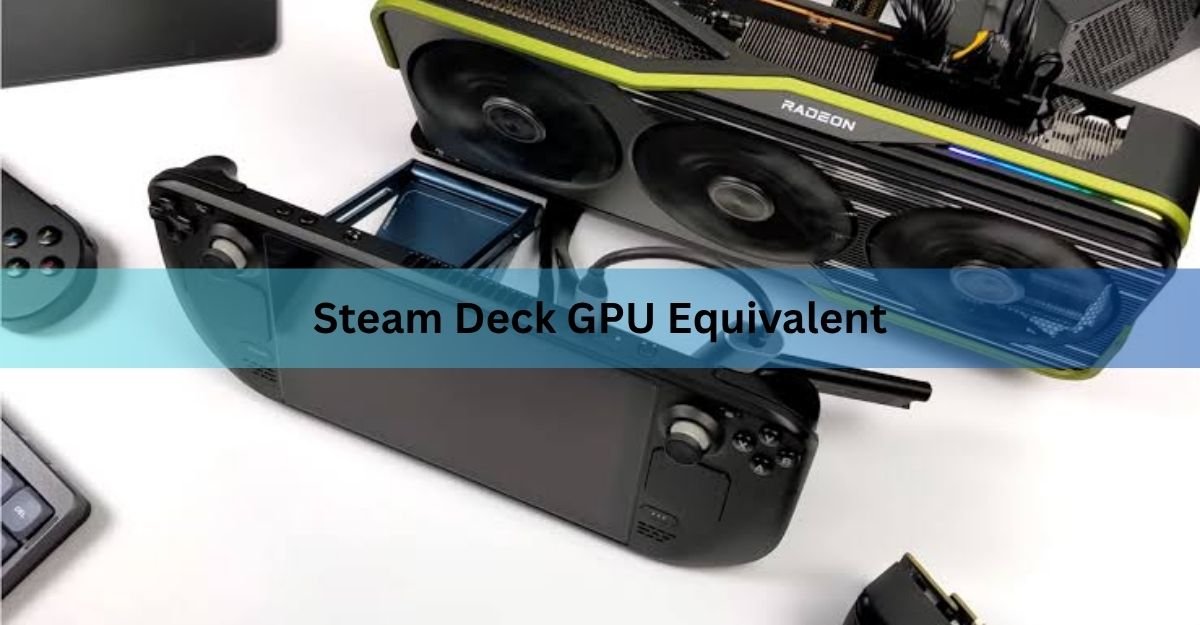
The Steam Deck does not have a separate graphics card. It runs on a custom AMD APU, a single chip that combines the processor and the graphics on one piece of silicon. The graphics part uses AMD’s RDNA 2 design, the same broad family behind the PlayStation 5, the Xbox Series consoles, and the desktop Radeon RX 6000 cards. It has been scaled far down to fit inside a handheld that sips power.
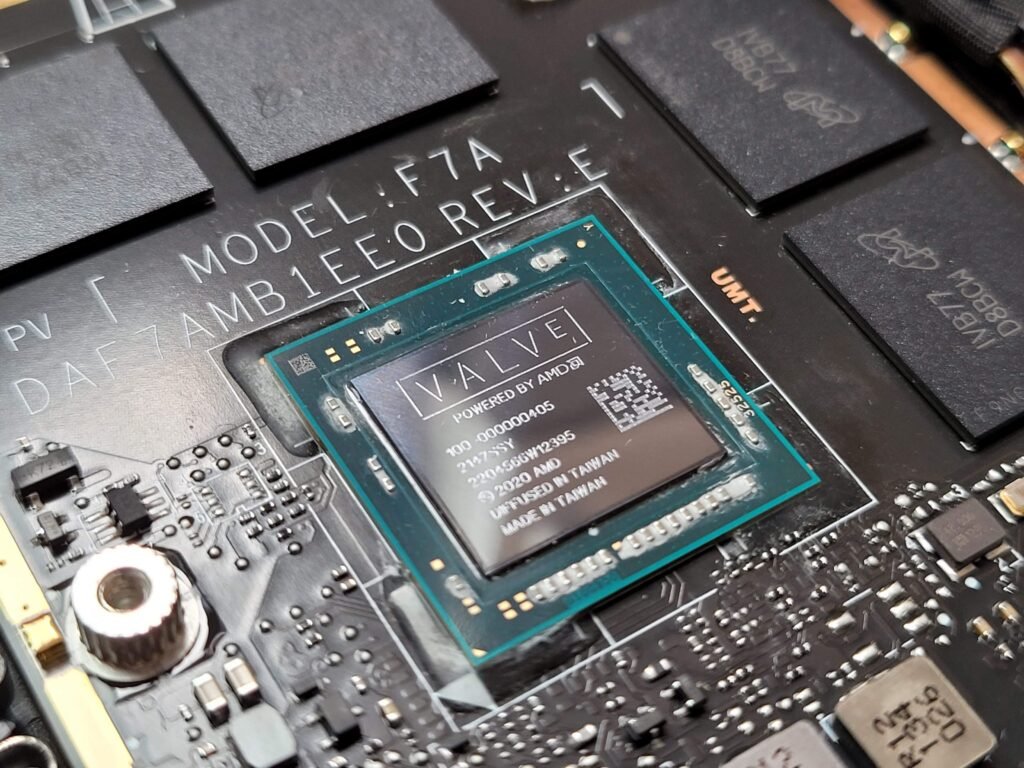
Here are the core numbers, straight from Valve’s Steam Deck tech specs. The GPU has 8 RDNA 2 compute units running at 1.0 to 1.6 GHz, which works out to 512 shader cores and about 1.6 TFLOPS of FP32 performance. The whole APU draws between 4 and 15 watts. It shares 16 GB of LPDDR5 memory with the processor instead of having its own dedicated video memory, with total bandwidth around 88 GB/s.
The Steam Deck OLED uses a revised chip built on a smaller 6 nm process. It runs cooler and lasts longer on a charge, but the graphics core is unchanged: same 8 compute units, same performance class. So everything below applies to both the original LCD Deck and the OLED version.
The closest desktop GPU equivalent
On raw output, the Steam Deck’s graphics sit in the same neighborhood as some older budget cards. Its roughly 1.6 TFLOPS figure lands right around the NVIDIA GTX 1050 and just below the GTX 1050 Ti. On the AMD side, the nearest match is the Radeon RX 560, with the Deck falling somewhere between an RX 550 and RX 560 depending on the game.
The catch is that TFLOPS is a lab number. It measures raw math throughput and does not fully predict real frame rates, because memory bandwidth, driver behavior, game engine quirks, and how hard the processor is working all feed into the final result. Two chips with the same TFLOPS can behave very differently once a real game is loaded.
Rule of thumb: think GTX 1050 Ti or RX 560 for a fair baseline, and a GTX 1650 as the ceiling the Deck reaches only in games that are tuned well for it.
Steam Deck vs common desktop cards
This table lines up the Deck against the desktop cards people ask about most. The power figures show why the comparison is never quite apples to apples: the Deck does its work on a fraction of the wattage.
| GPU | Approx. TFLOPS | Board power | Best-fit vs Deck |
|---|---|---|---|
| Steam Deck (8 CU RDNA 2) | ~1.6 | 4–15 W (whole APU) | Baseline |
| GTX 1050 | ~1.9 | ~75 W | About equal |
| GTX 1050 Ti | ~2.1 | ~75 W | Slightly ahead |
| Radeon RX 560 | ~2.6 | ~80 W | Slightly ahead |
| GTX 1650 | ~3.0 | ~75 W | Clearly ahead |
| RX 6500 XT | ~5.8 | ~107 W | Well ahead |
| RTX 3050 | ~9.0 | ~130 W | Different class |
Read the board power column carefully. A GTX 1650 pulls around 75 watts on its own; the entire Steam Deck, screen and processor included, tops out near 15. That gap is the whole point of the device, and it is why raw-number comparisons flatter the desktop cards more than day-to-day play suggests.
Why the Deck punches above its spec sheet
If you only looked at the specs, you might expect the Steam Deck to struggle with modern games. In practice it runs a huge range of current titles well. A few things close the gap between the paper numbers and the real experience.
- It targets a small screen. The Deck’s native resolution is 1280 by 800, close to 720p. Pushing far fewer pixels than a 1080p or 1440p display makes the modest GPU go much further.
- Software is tuned for it. Valve maintains a Verified program that flags which games run well, and the Deck’s SteamOS and drivers get regular optimization. Many games ship with settings profiles built for the hardware.
- Shared memory and cache help. Because the processor and graphics live on one chip and share fast memory, the Deck avoids some bottlenecks a cheap desktop card with a separate, narrow memory bus runs into.
- You control the power budget. You can cap frame rates at 30, 40, or 45 and dial the wattage to match, which keeps performance steady and stretches battery life.
The result is that games like Elden Ring, Cyberpunk 2077, and God of War run at playable frame rates at 720p to 800p with medium-ish settings, which is more than the bare 1.6 TFLOPS figure would lead you to guess. AMD’s FSR upscaling can add extra headroom in games that support it.
What the Deck can’t match
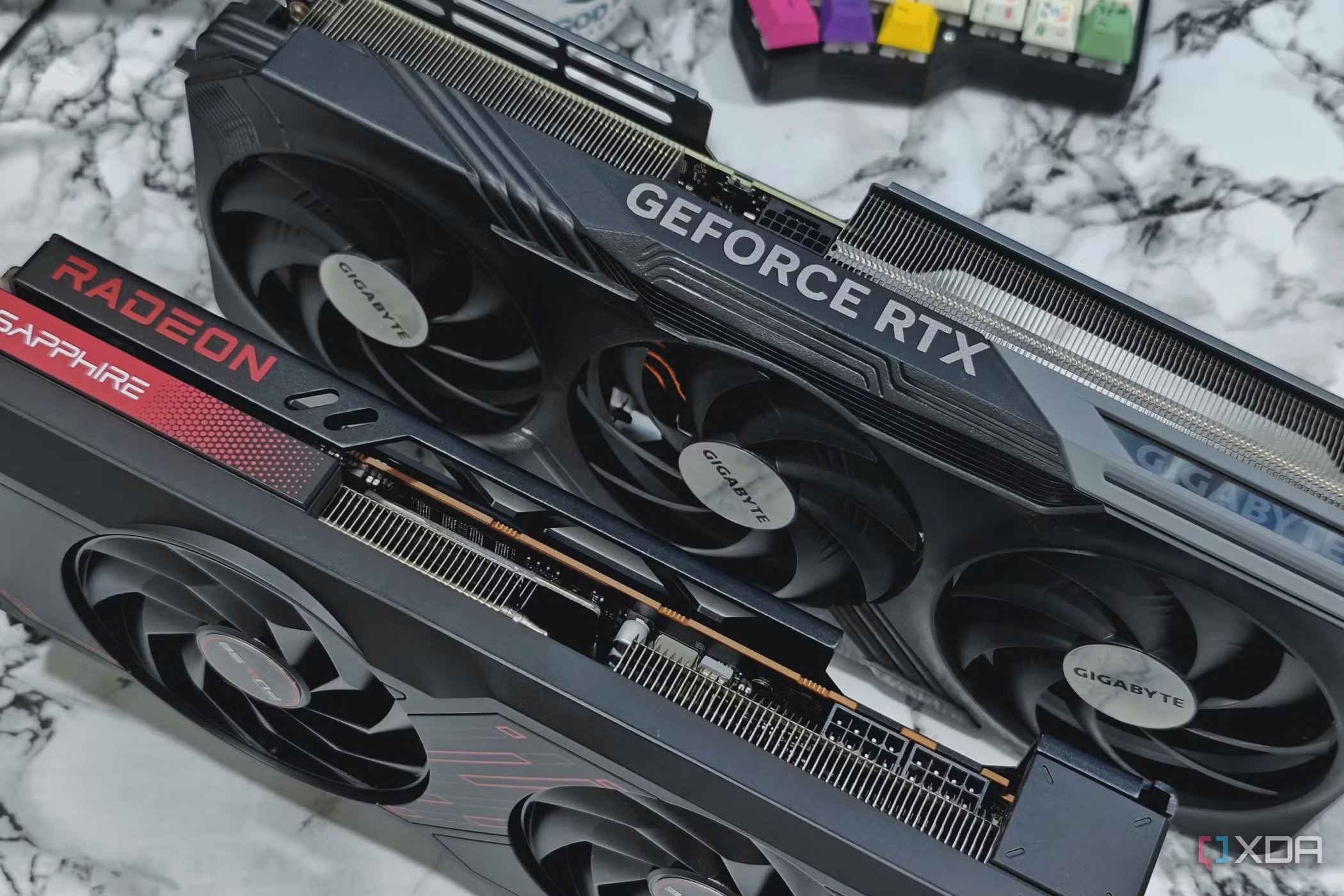
The equivalence has limits, and it is worth being honest about them. The Steam Deck is built for efficient handheld play, not for maxing out demanding games. A modern budget desktop card in the RX 6500 XT or RTX 3050 range is in a genuinely higher tier, with two to five times the raw graphics throughput.
At 1080p and above, the difference is obvious. Plug the Deck into a big monitor or TV and ask for high settings at 1080p60, and it will fall short in heavier games where an RTX 3050 keeps going. The Deck also has very little practical ray tracing ability; the hardware technically supports it, but the power budget makes it impractical in most titles. If your goal is high-resolution, high-frame-rate gaming, no handheld at this power level is the right tool.
How it compares to laptop and integrated graphics
Against laptop hardware, the picture flips depending on what you compare it to. The Steam Deck comfortably beats the integrated graphics in most thin-and-light laptops, including older Intel Iris Xe and NVIDIA MX chips, and it clears AMD’s older Vega-based integrated graphics. For a device its size, that is a strong showing.
But a gaming laptop with a discrete GPU, even an entry-level GTX 1650 mobile chip, will pull ahead in raw performance. The trade is the usual one: those laptops are bigger, heavier, louder, and hungrier for power. The Deck gives up some frames to be something you can hold in two hands on a couch or a train.
So which GPU should you picture?
If you need a single card to hold in your head, use the GTX 1050 Ti for NVIDIA or the RX 560 for AMD. That is the honest center of the Deck’s real-world performance. Treat the GTX 1650 as the upper edge it reaches in games optimized for it, and treat anything from the RX 6500 XT upward as out of its league.
More useful than any single card name is the mental model: the Steam Deck is a purpose-built 720p to 800p gaming machine that trades peak power for portability and efficiency. Judge it by what it plays well at its own resolution, not by how it stacks up on a desktop card’s home turf. If you want to sanity-check a specific game before buying, community reports on tools like ProtonDB show how real titles actually run on the hardware.
Frequently asked questions
Is the Steam Deck as powerful as a GTX 1650?
Not quite in most games. The Deck’s baseline sits nearer a GTX 1050 Ti, and it only approaches GTX 1650 performance in titles that are well optimized for its hardware and run at its low native resolution.
Can the Steam Deck run games at 1080p?
Yes, on an external screen, but with lowered settings in demanding games. Its native 1280 by 800 panel is where it performs best; pushing 1080p adds load that eats into frame rates.
Does the Steam Deck OLED have a better GPU?
No. The OLED model uses a smaller, more efficient chip, but the graphics core is the same 8 compute units and the same performance class. It runs cooler and lasts longer, without more raw power.
How much VRAM does the Steam Deck have?
It has no dedicated VRAM. The graphics share the system’s 16 GB of LPDDR5 memory with the processor. A default slice goes to graphics, and games draw more from the shared pool as needed.
Is a Steam Deck better than a budget gaming PC?
For portability, yes. For raw performance at 1080p, a desktop with an RX 6500 XT or RTX 3050 is stronger. The Deck wins on efficiency, size, and the ability to play anywhere.
Conclusion
The Steam Deck’s graphics perform closest to a desktop GTX 1050 Ti or Radeon RX 560, reaching toward a GTX 1650 in well-optimized games at its native low resolution. It does this on a tiny fraction of a desktop card’s power, which is why it plays modern games far better than 1.6 TFLOPS suggests. Picture it as a capable 720p to 800p machine, aim for medium settings and sensible frame caps, and it delivers a smooth, portable experience.